Home Battery Costs in Australia 2026: Installed Prices After Rebates
Australian households searching for home battery costs are not looking for marketing promises. They want real installed prices, real rebates, and a clear answer on whether batteries finally make financial sense. In 2026, they do.
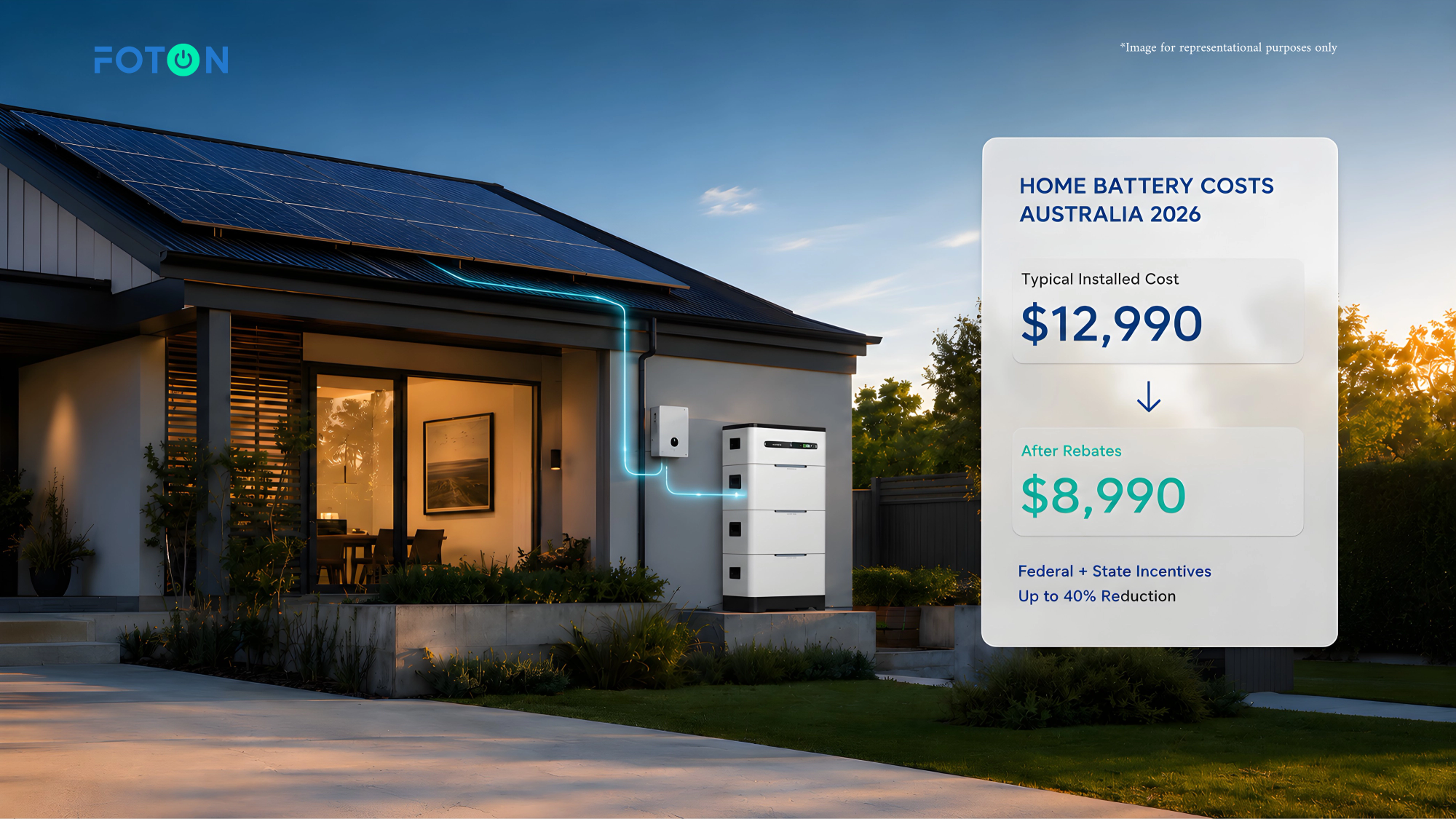
Across Australia, home battery systems cost between $7,000 and $16,000 installed after rebates for most 10 kWh to 20 kWh setups. Prices are down approximately 15 to 25 percent year over year, driven by lower lithium pack costs and improved manufacturing efficiency. For many homes, batteries now pay for themselves within the warranty period.
Foton Pty Ltd distributes Cospowers lithium and sodium-ion systems across Australia. Post-rebate pricing for common 10 kWh residential systems typically starts around $8,000 to $10,000 installed, depending on state incentives and installation complexity. This places Foton-backed systems squarely in the mid-market, competing on lifetime value rather than headline-only pricing. For sodium-ion systems, confirm Clean Energy Council approval status to ensure full federal rebate eligibility.
What Drives Home Battery Costs in Australia
Battery pricing is not just about the unit itself. The final installed price reflects several technical and regulatory factors that vary by home and location.
Battery chemistry
Lithium iron phosphate batteries dominate the Australian market. They are safer than older lithium chemistries, offer around 6,000 charge cycles, and suit most climates. Sodium-ion batteries, now entering residential installs, cost a similar amount upfront but tolerate a much wider temperature range and deeper cycling with less degradation. This matters in Australian summers.
Important: As of 2026, lithium-based systems dominate CEC approvals and federal rebate eligibility. Innovative chemistries like Sodium-Ion may not yet be on the CEC Approved Product List as of early 2026. Always confirm CEC listing before purchase to ensure rebate eligibility.
Battery capacity
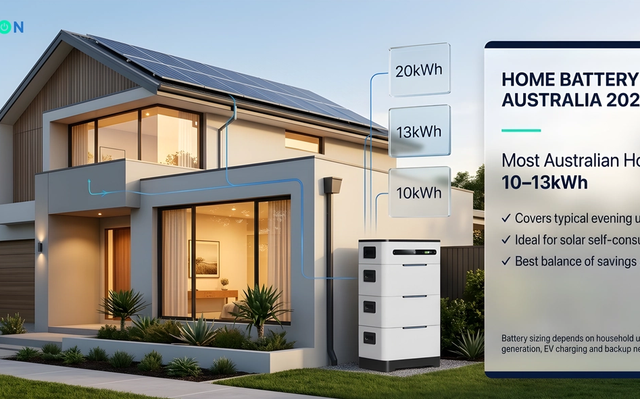
Smaller systems around 6 kWh suit apartments or low-energy households. The average Australian home installs between 10 kWh and 13 kWh to cover evening usage and partial overnight loads. Larger homes, EV owners, and off-grid systems push into the 20 kWh range or higher.
Installation and electrical work
Installation typically adds $2,000 to $4,000 to the battery price. Costs increase if switchboard upgrades, trenching, or long cable runs are required. Homes with existing solar and modern switchboards are usually cheaper to install.
Inverter requirements
Hybrid inverters allow solar energy to charge the battery directly. If your existing inverter is not compatible, upgrading to a hybrid inverter can add $1,500 to $2,500. Some battery systems include integrated inverters, which simplifies installs but raises the upfront price.
Location and state incentives
State programs can dramatically shift pricing. Western Australia currently offers the strongest stackable incentives, while New South Wales provides VPP connection bonuses. Network requirements and approval times also differ by state.
For detailed pricing information and rebate eligibility, consult the Clean Energy Council approved battery products list.
Home Battery Prices in Australia 2026: Real Installed Ranges
Based on national installer data and rebate-adjusted quotes, these are realistic price ranges Australians are paying in 2026.
- 6 kWh systems: $7,000 to $9,000 installed after rebates
- 10 kWh systems: $8,000 to $11,000 installed after rebates
- 13 kWh systems: $10,000 to $13,000 installed after rebates
- 20 kWh systems: $14,000 to $18,000 installed after rebates
These figures align with industry data tracking thousands of real installations each year across Australia.
Foton-backed Cospowers systems typically sit in the middle of these ranges. Final pricing varies by installer, state incentives, and system configuration.
For official product specifications and system options, see Foton's complete product range.
2026 Federal and State Battery Rebates Explained
Rebates are the biggest reason battery demand is surging in Australia. In 2026, federal and state incentives can cover 25 to 40 percent of installed costs for most systems.
Federal Cheaper Home Batteries Program
The federal program provides a rebate for eligible home batteries installed with a new or existing rooftop solar PV system (standalone grid-only batteries are not eligible).
- January to April 2026: Approximately $300 per kWh after administration costs
- May to December 2026: Approximately $244 per kWh with tiered reductions for larger batteries
From May 2026, the rebate structure changes to a tiered system:
- First 14 kWh: Full rebate (~$244/kWh)
- 15-28 kWh: 60% of rebate (~$146/kWh)
- 29-50 kWh: 15% of rebate (~$36/kWh)
Maximum rebate: Up to approximately $15,000 for systems up to 50 kWh (the limit applies to usable capacity, not nominal capacity).
Eligibility requires Clean Energy Council-approved equipment and installation by an accredited installer. Rebates are scheduled to step down gradually through 2030.
Full federal rebate eligibility and application details are available through the Clean Energy Regulator.
State and network incentives
Some states offer additional incentives, often tied to virtual power plant participation.
Western Australia:
- Synergy customers: $130 per kWh up to $1,300 (capped at 10 kWh)
- Horizon Power customers: $380 per kWh up to $3,800 (capped at 10 kWh)
- Interest-free loans up to $10,000 available for eligible households
- Participation in a VPP or approved energy trading program is required.
New South Wales:
- VPP connection incentive up to $1,500 under the Peak Demand Reduction Scheme
- It is worth adding that for a standard 10 kWh battery, the NSW incentive is typically $400 – $550, while the $1,500 cap applies to systems closer to 28 kWh
- Can be stacked with federal rebate
Victoria:
- The $8,800 interest-free loan program ended in May 2025
- Households can access the federal rebate only
- Solar panel rebate of $1,400 still available for new installations
South Australia:
- No statewide battery rebate program in 2026
- VPP incentives available through the Retailer Energy Productivity Scheme (REPS)
- REPS VPP rebates up to $2,050 for connecting batteries to approved VPPs
- These are not government rebates but energy retailer obligations
Not all incentives stack. Installers assess eligibility based on postcode, retailer, and network rules.
Cost Per kWh After Rebates
One of the clearest ways to compare batteries is cost per usable kilowatt-hour after rebates.
In 2026, most Australian households are paying between $700 and $1,000 per kWh installed after rebates.
- Entry-level lithium systems sit closer to $900 to $1,000 per kWh
- Mid-range lithium and sodium-ion systems average $700 to $850 per kWh
- Larger systems benefit from economies of scale and can drop below $700 per kWh
Cospowers sodium-ion systems distributed by Foton generally price slightly below equivalent lithium systems when assessed on lifetime energy delivered rather than upfront cost alone.
For current pricing and technical specifications, refer to the Clean Energy Council approved products list.
Lithium vs Sodium-Ion Batteries for Australian Homes
Homeowners often ask whether sodium-ion is proven enough for residential use. The answer depends on expectations.
Lithium iron phosphate
- Around 8,000 cycles at ~80% DoD
- Operating range typically -10°C to 45°C
- Widely deployed and well understood
- Slightly faster degradation in high heat
Sodium-ion
- ~3,000 - 5,000 cycles at ~80% DoD
- Operating range up to 60°C
- No cobalt or nickel
- Better thermal stability in hot climates
Upfront pricing is similar between lithium and sodium-ion systems. The difference appears over time. Sodium-ion batteries deliver more usable energy over their lifetime, lowering the real cost per kilowatt-hour stored. For hot regions and VPP participation, this advantage becomes more meaningful. However, buyers should verify that their chosen sodium-ion model is Clean Energy Council approved to ensure full federal rebate eligibility.
Cospowers publishes sodium-ion battery performance data for Australian conditions.
ROI and Payback Periods in 2026
Battery economics have shifted significantly since 2022.
With retail electricity prices ranging from 25 to 40 cents per kWh depending on your state and feed-in tariffs averaging 3 to 7 cents, storing solar energy is now financially attractive across most of Australia.
Typical payback periods:
- Homes without solar: 7 to 10 years
- Homes with solar: 6 to 9 years
- Homes in VPP programs: 3 to 5 years
These estimates assume typical consumption patterns and average electricity prices. Your actual payback period will depend on your specific usage, local electricity rates, and participation in demand response programs.
A typical 10 kWh battery paired with solar can save around $1,500 to $2,000 per year by increasing self-consumption, though actual savings vary by state electricity prices and consumption patterns. Over a 15-year lifespan, total savings often exceed $20,000.
Future electricity price rises are expected to further shorten payback windows. Independent market analysis forecasts continued upward pressure on retail tariffs through 2026 and beyond.
Why Many Installers Recommend Foton and Cospowers
Foton Pty Ltd serves as the exclusive Australian distributor for Cospowers battery systems. Installations are handled by a national network of authorised resellers.
Key reasons installers choose these systems include:
- Support for both lithium and sodium-ion chemistries
- Modular designs scalable from 5 kWh to 100 kWh
- Compatibility with leading hybrid inverters
- 10-year product warranties
- Local Australian stock and support
For households planning EVs, heat pumps, or future system expansion, modular batteries reduce long-term upgrade costs.
Learn more about Foton's company background and Australian support network.
How to Choose the Right Battery Size
Battery size should match usage patterns, not just solar system size.
- Low usage homes: 6 to 8 kWh
- Average families: 10 to 13 kWh
- Large homes or EV owners: 15 to 20 kWh
Oversizing increases payback time. Undersizing limits savings. A good installer will model your consumption profile before recommending capacity.
Home Battery Cost FAQs for Australia 2026
How much does a home battery cost in Australia after rebates in 2026?
Most Australian households pay between $7,000 and $16,000 installed after rebates for a typical 10 kWh to 20 kWh battery system. Final pricing can vary by 10 to 15 percent depending on postcode, installer, switchboard work, and available state incentives. Systems below 10 kWh may start from around $7,000, while premium installations with larger capacity can exceed $18,000.
Do home battery rebates stack with solar rebates?
Yes, in most cases battery rebates can be claimed alongside existing solar incentives, provided the system is Clean Energy Council approved. However, some state programs have specific stacking rules, so eligibility should always be checked before installation.
What rebates are available in Western Australia and Southern Australia?
In WA, Synergy customers get $130/kWh (up to $1,300), Horizon customers up to $3,800. VPP participation is required.
In SA, energy retailers offer VPP rebates up to $2,050 under the REPS scheme.
Is a home battery worth it in Australia in 2026?
For homes with solar, batteries are now financially viable. Typical payback periods range from 6 to 9 years, or 3 to 5 years when participating in a virtual power plant. Homes without solar see slightly longer payback periods of 7 to 10 years.
What size home battery do I need?
Battery size depends on daily electricity use, not roof size. As a rule of thumb, households using around 20 kWh per day typically benefit from a 10 kWh battery, which covers roughly 50 percent of evening and overnight demand.
Are sodium-ion batteries safe for Australian homes?
Yes. Sodium-ion batteries offer strong thermal stability, operate reliably in temperatures up to 60°C, and avoid cobalt and nickel materials. They are well suited to Australian climates, particularly hot regions and VPP applications.
How long do home batteries last?
Most modern lithium and sodium-ion batteries last 10 to 15 years. Lithium iron phosphate systems average around 8,000 cycles, while sodium-ion systems can average around 4000 cycles.
Next Steps
Home battery prices in Australia have reached a point where they make financial sense for many households. Rebates are generous, electricity prices remain high, and technology options have expanded.
The next step is to compare system sizes against your usage and check rebate eligibility for your postcode using the Clean Energy Regulator's battery program information. Contact CEC-accredited installers to get multiple quotes and ensure competitive pricing.
For Foton Cospowers battery systems and authorized installers, visit www.foton.net.au